Tabarrukat e Nabvi (s.a.w) Ka Tasveeri Album by Maulana Arsalan bin Akhtar Memon
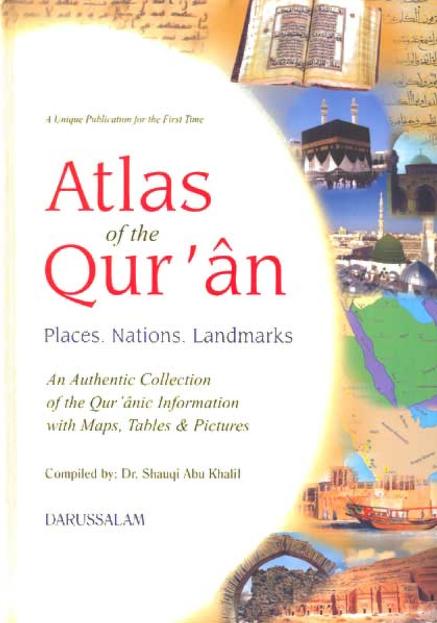
This atlas consists of pictures and maps of places, peoples, and important figures that are mentioned in Allah’s Book. The idea to produce this atlas first took root in my mind in the year 1990, when I looked at a map of the Arabian Peninsula and saw a small dot on it, beside which was written, ‘The grave of Prophet Hud.’ It was located in the eastern part of the city of Taryam, in Hadramawt. When I saw this, I asked myself: When a Muslim reads the Noble Qur’an and when he comes across the story of Hud does he know where Hud M actually lived? And when he reads the Chapter Al-Ahqaf (Curved Sand Hills), does he know where the intended sand hills are actually situated?
Without taking any definite shape, the idea continued to grow in my mind until I visited the city of Baku, wherein I came across a temple that used to be frequented by fire worshipers. It was there that I asked myself: in Allah’s Book, a Muslim reads about the Magians (Majus), but does he know where they lived and whether there are any remnants of them today?
The idea continued to grow and take form in my mind until it finally became ripe and complete. Since the way has already been paved for me through the many atlases that have been produced on various topics, I knew exactly what I had to do and what steps I needed to take in order to produce this atlas. I began the project, seeking help from Allah and placing my complete trust upon Him. The project seemed formidable to say the least, for no book of this kind has ever been produced in the Islamic world. True, some historians have written about the places and peoples that are mentioned in the Noble Qur’an, but their efforts have been restricted to a written description of those places and peoples, and even that
Written description is not comprehensive. They made no effort to present pictures and maps. Such history books include the likes of Mountains, Places, and Waters, by Az-Zamakhshari; and, Important Figures in the Noble Qur’an, by Yahya ‘Abdullah Al-Mu’allimi.
I began my efforts with an in-depth reading of Allah’s Book, looking for Verses that mentioned places, peoples, and important persons. Then came the research part of this endeavor, a stage that led to the drawing of the pictures and maps in this book, and the writing of the brief explanations that are written alongside them.
This does not mean that I did not face any obstacles during the course of this endeavor; to the contrary, I faced many obstacles, the least of which had to do with places and peoples of the Hereafter or of the unseen world – such as Sidratul-Muntaha, the people of A’rdf, Al-Kauthar, the Devil, and so on. It goes without saying that we cannot now associate such places, peoples, and beings with a map or a picture. The unseen world is just that – unseen. But one of the bigger obstacles that I was continually faced with had to do with certain books that expand on and explain the stories of the Qur’an as well as certain Tafsir books. The problem is that some of those books rely heavily on Israelite narrations, narrations that for the most part are taken from the Torah. Should we rely on such narrations?
 supremeseerah.com